
Maithili is spoken by millions across the Indian state of Bihar and beyond. While it shares roots with the more widely known Hindi, Maithili’s unique vocabulary offers a fascinating window into the traditions, values, and daily experiences of the Maithili-speaking community.
In this blog post, we’ll look at some common Maithili words and their meanings. Whether you’re a Maithili speaker or just interested in languages, you’re sure to find these words interesting.
Before we immerse ourselves in the vibrant Maithili vocabulary, it’s important to understand the diverse linguistic influences that have shaped this language over time.
Let’s take a brief look at the origins of the Maithili language’s words, setting the stage for our deeper exploration ahead.
The Origins of Maithili Language Words
Maithili’s vocabulary draws from Sanskrit, Prakrit dialects, and neighboring languages like Bhojpuri and Bengali, giving it a distinct character even where it overlaps with Hindi.
For the full story of Maithili’s origins, script, and where it’s spoken today, see our post on the history and origins of the Maithili language.
This mix of influences has given Maithili a unique richness and diversity. It offers a special window into the cultural traditions and values of the Maithili-speaking communities.
100 Common Maithili Words and Their Meanings
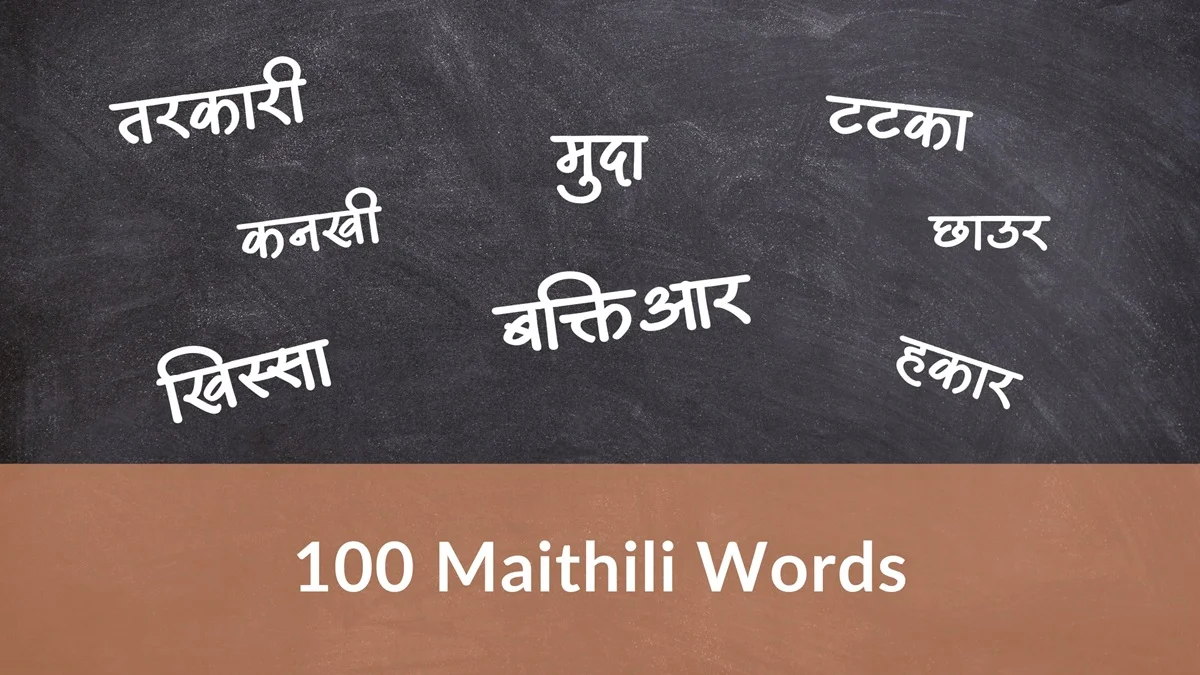
Now, let’s dive into a curated selection of 100 Maithili words that capture the essence of this remarkable language. Each one gives us a glimpse into the Maithili way of life.
Communication
- केहन (Kehan) – How
- किम्हर (Kimhar) – Where
- कहिया (Kahiya) – When
- किए (Kiae) – Why
- कि (Ki) – What
- अहाँ (Ahan) – You (formal)
- हम (Ham) – I, we
- बुझलऊं (Bujhlaun) – Understood (formal)
- मुदा (Muda) – But
- जखन (Jakhan) – Of which time
- तखन (Takhan) – On that moment
- लगले (Lagle) – Immediately
- मुहा-मुही (Muha-muhi) – Face-to-face
Emotions & Expressions
- नोर (Nor) – Tears
- उत्किरना (Utkirna) – Praise
- नीक (Neek) – Good/nice
- अकच्छ (Akacch) – Annoyed
- कनखी (Kankhi) – Side glance
- मुस्की (Muski) – Smile
- मोन (Mon) – Wish/desire
Family & Relationships
- कनिया (Kaniya) – Bride, wife
- बौर (Baur) – Groom, husband
- संगी (Sangi) – Friend
- बहीन (Bahin) – Sister
- भैए (Bhae) – Brother
Nature & Environment
- रउद (Raud) – Sunlight
- गाछ (Gaach) – Tree
- तरकारी (Tarkari) – Vegetable
- अन्हार (Anhaar) – Darkness
- इजोत (Ijot) – Light
- बेर (Ber) – Time
- भोर (Bhor) – Morning
- सांझ (Saanjh) – Evening
- फरीछ (Pharichh) – Light/clear
Food & Cuisine
- खेनाइ (Khenai) – Food
- भात (Bhaat) – Cooked rice
- भोज (Bhoj) – Feast
- भानस (Bhanas) – Cooking
- भनसिया (Bhansiya) – Cook
- भनसा घर (Bhansa ghar) – Kitchen
Plants & Animals
- बानर (Banar) – Monkey
- महीख (Maheekh) – Buffalo
- मूस (Mus) – Rat/mole
- सपनौर (Sapnaur) – Mongoose
- कटहर (Kathar) – Jackfruit
- कदीमा (Kadima) – Pumpkin
- मखान (Makhan) – Foxnut
- सजमइन (Sajmain) – Bottle gourd
- माछ (Maach) – Fish
- लजबिज्जी (Lajbijji) – Touch-me-not plant
- लत्ती (Latti) – Creeper
Objects & Items
- थारी (Thaari) – Plate
- बाटी (Baati) – Bowl
- केवारी (Kevari) – Door
- इनार (Inaar) – Well
- नूआ (Nua) – Saree/Dhoti
- टका (Taka) – Money
- लई (Lai) – Adhesive
- लहठी (Lahthi) – bangles made of lac
- छाउर (Chhaur) – Ashes
- झोल (Jhol) – Spider’s web blackened with smoke and dust
- धधरा (Dhadhra) – Flame
Body Parts
- कलेबर (Kalebar) – Body/stature
- मूड़ी (Mudi) – Head
- गोड़ (Gor) – Feet
- ठेहुन (Thehun) – Knee
Adjectives
- काजुल (Kajul) – Active
- लजकोटर (Lajkotar) – Shy/coy
- लबरा (Labra) – Liar/talker (Male)
- हहास (Hahas) – Wrath
- हाफी (Haphi) – Yawn
- हरारत (Hararat) – Fatigue
- हरखित (Harkhit) – Glad
- हेहर (Hehar) – Impudent
- थेत्थर (Thetthar) – Shameless
- थोका (Thoka) – Bunch
- फोंफ (Phonph) – Snore
- बक्तिआर (Baktiar) – Increase, prosperity
- बखरा (Bakhra) – Share
- बताह (Batah) – Mad
- छरहर (Charhar) – Slim
- लहालोट (Lahalot) – Overjoyed
- लरगुज (Larguj) – Limp
- छिछराह (Chhichrah) – Slippery
- टनकी (Tanki) – Intermittent aching
- फाटल (Phatal) – Torn
- टटका (Tatka) – Recent, latest/fresh
- जनमउटी (Janmauti) – Newborn
- चरफर (Charphar) – Clever
- एहन (Ehan) – Almost similar to this
- अनमन (An-man) – Exactly
- भकचक (Bhakchak) – Astonishment
Miscellaneous
- काज (Kaaj) – Work
- मोलाई (Molai) – Bargain
- सनेस (Sanes) – Gift/present, message
- फकरा (Phakra) – Child’s play rhyme
- हकार (Hakar) – Invitation
- हुल्की (Hulki) – Peep
- खिस्सा (Khissa) – Story
- पावएन (Pavain) – Festival
More to Explore!
Through these 100 Maithili language words, we’ve stepped into the heart of a language rich with history, emotion, and cultural nuances. Each word tells its own story, from the practicalities of everyday life to the warmth of family connections, the beauty of nature, and the depth of human expression.
Whether you’re brushing up on your Maithili or getting acquainted with it for the first time, we hope these words bring you closer to the beauty and richness of Maithili.
Stay tuned for more such exhilarating explorations of the Maithili language!
FAQs About Maithili Language
Are these Maithili words used in everyday conversation, or are they more formal/literary?
Most of the words in this list are everyday, spoken Maithili (the kind used at home, in the market, or with family) rather than formal or literary vocabulary. A few, like terms tied to festivals or rituals, lean more traditional.
Can I start using these words if I don’t speak Maithili fluently?
Yes. Many people learning Maithili start exactly this way, picking up common words and phrases before tackling full sentences or grammar. Mixing a few Maithili words into conversation with family or friends is a natural first step.
Do Maithili words sound different depending on the region?
Pronunciation and word choice can vary slightly between areas. For instance, some words common in Darbhanga may sound a little different in Madhubani or the Nepal Terai. The meanings, though, generally stay consistent across regions.
Are these words written the same way in Devanagari as they’re spoken?
Largely yes, since Maithili is now most commonly written in Devanagari. Some words carry subtle pronunciation nuances that don’t fully translate to script, which is part of what makes hearing the language spoken so valuable alongside reading it.
Is there a way to keep learning more Maithili vocabulary beyond this list?
This list covers 100 common words, but Maithili’s vocabulary is much richer. Following native speakers on social media, listening to Maithili folk songs, or spending time with Maithili-speaking family and friends are some of the best ways to keep building vocabulary naturally.