

India is a vibrant mosaic of beautiful, diverse languages, each enriching the nation’s cultural and literary heritage. Like many of India’s remarkable languages, Maithili proudly showcases a profound and extensive repository of literary brilliance. It is deeply tied to the culture and traditions of the Mithila region.
One of the most fascinating facets of the Maithili language’s charm is the fakra, an age-old form of satire and humor. Let’s explore what makes these idiomatic expressions an integral part of Maithili.
What is a Fakra?
The term ‘fakra’ refers to witty idioms and sayings rich in sarcasm, humor, and insight. These expressions go beyond mere amusement. They reflect societal norms, cultural practices, and human behavior.
Maithili fakras serve as a remarkable example of how literary devices not only reflect societal norms and values but also influence and are influenced by them in return. Above all, they offer sharp commentary on life and human nature through their tongue-in-cheek tone.
The Significance of Fakras
Fakras, along with lokoktis (proverbs) and muhavare (idioms), are treasures of regional wisdom passed down through generations. They are concise, impactful, and resonate across all aspects of life. Whether guiding, inspiring, or entertaining, these sayings embody the essence of lived experiences.
For the Maithil people, fakras are more than Maithili words. They reflect daily life, cultural values, and timeless wisdom. From humorous observations to cautionary tales, they encapsulate the spirit of human nature.
Most of us can fondly remember a Nani, Dadi, or even a witty neighbor effortlessly quoting the perfect idiom for every situation. In this article, we’ll revisit some of the most popular Maithili fakras—a nostalgic journey guaranteed to leave you smiling and nodding in recognition, even if you’re not a Maithil.
45+ Most Popular Maithili Fakras and Their Meanings
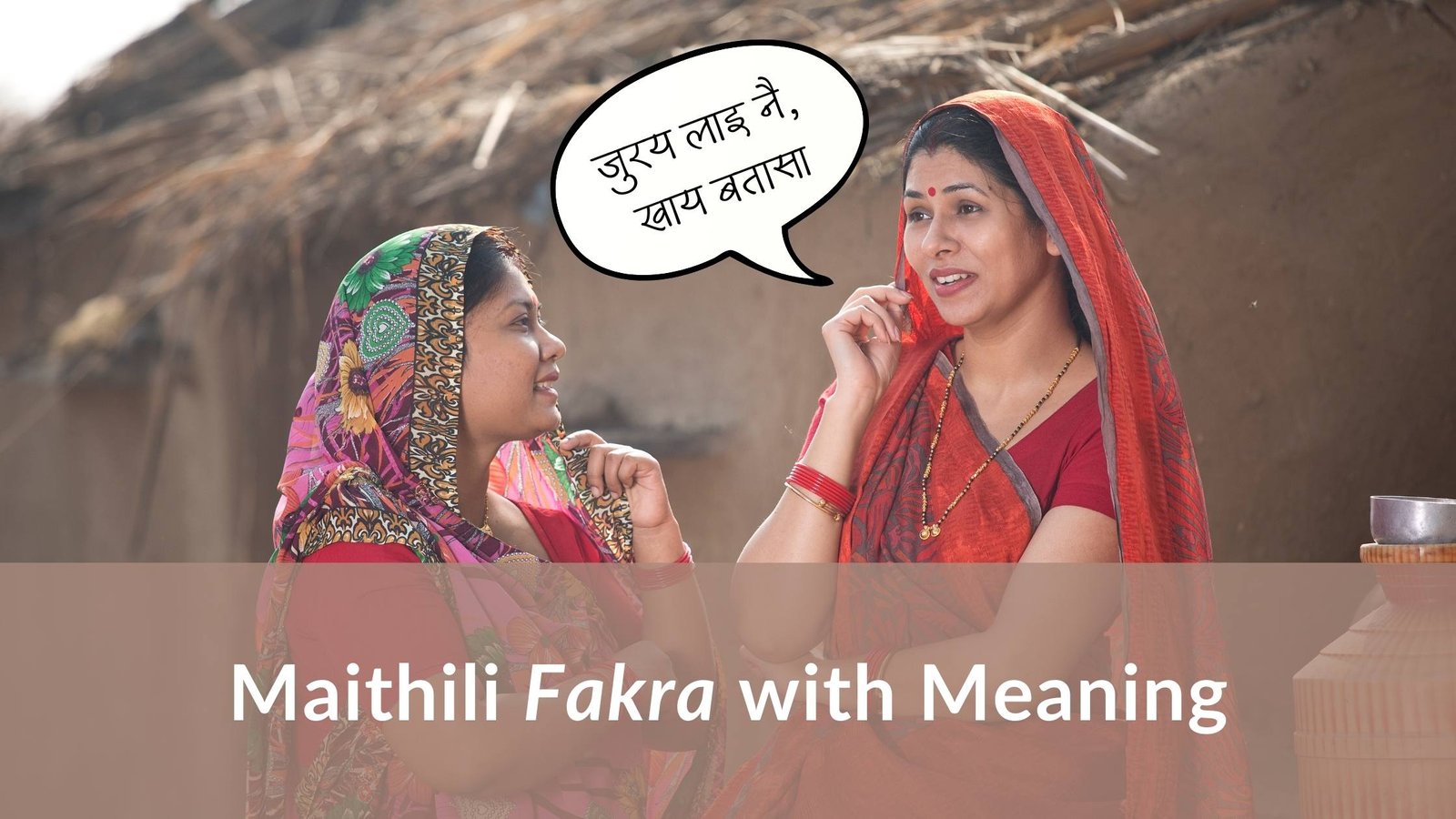
1. जुरय लाइ नै, खाय बतासा
(Jurai lai nai, khaai batasa)
English translation: Can’t afford ‘lai’ (a humble sweet made of puffed rice and jaggery) but eats ‘batasha’ (aerated sugar candy).
Meaning: Living beyond one’s means.
2. नाच न जाने आंगन टेढ़
(Naach an jaane aangan tedh)
English translation: Doesn’t know how to dance but blames the stage.
Meaning: Blaming others for one’s own shortcomings.
3. माय हेरे अँतड़ी, बौह हेरे पोटरी
(Maai here antri, bahu here potri)
English translation: Mother worries about whether he has eaten; wife worries about his earnings.
Meaning: One tends to worry more about the well-being of their creation.
4. साँय बहु में झगड़ा, पंच भेल लबरा
(Saain bahu mein jhagra, panch bhel labra)
English translation: Husband-wife’s fight, mediator becomes a motormouth.
Meaning: Interfering in others’ matters rarely leads to positive outcomes.
5. बाप के नाम लत्ती फत्ती, बेटा के नाम कदीमा
(Baap ke naam latti fatti, beta ke naam kadima)
English translation: Father’s name is foliage, son’s name is pumpkin.
Meaning: The son is five steps ahead of the father.
6. पाइन में माछ, नौ नौ कुटिया बखरा
(Paen mein maach, nau nau kutiya bakhra)
English translation: The fish is still in the water, and nine pieces each share has already been divided.
Meaning: Dividing the shares even before the fish is caught. Simply put, building castles in the air.
Another farka with the same meaning is बाप छल पेट में, पूत गेल गया (Baap chhal paet mein, poot gael Gaya). This translates to “the father’s already in the womb, and the son has gone to Gaya (to do his last rites).”
7. मूर्खक लाठी, बिच्चे कपार
(Murkhak laathi, bichhe kapar)
English translation: The fool’s stick lands squarely on the forehead.
Meaning: Avoid engaging with fools; it only worsens things.
8. मुरखाहा के धन भेल, कबिलाहा ठगि ठगि खाय
(Murkhaha ke dhan bhel, kabilaha thagi thagi khaay)
English translation: The fool’s got wealth, the intelligent cleverly snatches and eats.
Meaning: Clever people easily exploit a fool’s wealth.
9. भुसकोल विद्यार्थी के गत्ता मोट
(Bhuskol vidyarthi ke gatta mot)
English translation: The foolish student brings the thickest exam pad.
Meaning: The weakest often appears the most prepared.
10. खस्सी के जान जाय, खवैया के स्वादे नैय
(Khassi ke jaan jaay, khewaiya ke swaad nai)
English translation: The lamb’s life is at stake, yet the eater finds it unappealing.
Meaning: Even extravagant efforts may not satisfy critics. Faultfinders never refrain from pointing out shortcomings.
11. काँइख तरि अँचार, आ देखाबय पोथी के विचार
(Kaankhi tari achaar, aa dekhaibe pothi ke vichaar)
English translation: Keeping a pickle under the arm and displaying wisdom.
Meaning: Speaking lofty ideals in front of others while concealing negative emotions within. Or a gap between words and actions.
13. हम चराबी दिल्ली दिल्ली आ हमरा चरबय घरक बिल्ली
(Hum charabi dilli dilli aa humra charbay gharak billi)
English translation: I herd Delhi and beyond, and the pet cat herds me.
Translation: At home, one surrenders, regardless of one’s authority outside.
14. बाड़ी के पटुआ तीत
(Baadi ke patua teet)
English translation: The garden’s produce is bitter.
Meaning: One often takes for granted what is easily available. Or, familiarity breeds contempt.
15. खो मंगला परल रह
(Kho mangla padal rah)
English translation: Eat Mangla (a person’s name) and keep lounging.
Meaning: A lazy person eats and sleeps all day.
16. जेत्ते क बौह नै ओत्ते क लहठी
(Jatte ke bahu nai otte ke lahthi)
English translation: The cost of the bangle exceeds that of the bride.
Meaning: Expenses outweigh the benefits.
17. चलनी दुसलक सूप के, जेकरा सहस्सर छेद
(Chalni duslak soop ke jekra sahharsar ched)
English translation: Seive condemns soop (a bamboo vessel), yet it itself has thousands of holes.
Meaning: Flawed people find faults in others.
18. सडलो भुन्ना त रोहू के दुन्ना
(Sarlo bhunna ta rohu ke dunna)
English translation: Even a stale ‘bhunna’ (hilsa fish) is twice the price of rohu (fish).
Meaning: Even the inferior of rare things is costlier than the finest of common ones.
19. हरबरी के बियाह में कनपट्टी पर सिन्दूर
(Harbari ke byaah mein kanpatti par sindoor)
English translation: In a hurried wedding, the groom ends up applying vermilion on the bride’s temple instead of her hair parting.
Meaning: Excessive haste ruins work.
20. बात मानलौं मुदा खुट्टा गारब बिच्चे में
(Baat maanloun muda khutta gaarab bichhe mein)
English translation: I agree but I’ll bury peg in the middle.
Meaning: I agree, but I’ll do as I please.
21. आईंठो खेलहुँ, पेटो नहि भरल
(Aaithon khelaun, peto nai bharal)
English translation: I ate the leftovers, but my stomach still wasn’t full.
Meaning: Not getting full benefits even after making compromises.
22. लंका मे जे सबसे छोट से उन्नचास हाथ
(Lanka mein je sabse chhot se unnchaas haath)
English translation: Even the smallest in Lanka was 49 feet.
Meaning: Even the weakest in a bad environment is a big problem.
23. कौआक सरापे बेंग नै मरए
(Kauak sarape beng nai marai)
English translation: A frog doesn’t die from a crow’s curse.
Meaning: The strong are unaffected by the criticism of the weak.
24. हम सुनरी पिया सुनरी, गामक लोक बनरा बनरी
(Hum sunri piya sunri, gaamak log banra banri)
English translation: Only my beloved and I are beautiful; everyone else looks like a monkey.
Meaning: A person is so infatuated that they see only the best in their loved one and disregard everything else.
25. अन्हार घर सांपैह साँप
(Anhaar ghar saanpeh saanp)
English translation: In a dark room, everything looks like a snake.
Meaning: When you are fearful, even ordinary problems seem overwhelming.
26. अन्हेर गायके राम रखबार
(Anher gaayke raam rakhbaar)
English translation: A blind cow is protected by Lord Ram.
Meaning: God protects those who have no one else to care for them.
27. छोट खिखिरके मोट नांगैर
(Chhot khikhir ke mot naanger)
English translation: Small foxes have thicker tails.
Meaning: A small, insignificant person can still have an inflated sense of importance or ego.
28. जेहने तकलह हौ कुटुम, ओहने भेटलह हौ कुटुम
(Jehne talkah hau kutum, ohne bhetlah hau kutum)
English translation: Like the company you keep, likewise the people you find.
Meaning: You attract the people who reflect your own nature or intentions.
28. जेबय नेपाल कपार जेतय संगे
(Jebai Nepal kapaar jetai sange)
English translation: I’ll go to Nepal, and my forehead will go with me.
Meaning: Wherever you go, your destiny goes with you.
29. नानी’के धन , पानी’के धन आ बेईमानी’के धन…ई तीनो नञि रहछि
(Naani ke dhan, paani ke dhan aa beimaani ke dhan…ee teeno nai rahai achi)
English translation: The wealth received from your maternal grandmother, water, and illicit means does not stay.
Meaning: Wealth gained through illegitimate or unreliable means is never lasting.
30. पाकल परोड़ के झनझन बीया
(Paakal paror ke jhanjhan beeya)
English translation: The seeds of a ripe gourd make a lot of irrelevant sounds.
Meaning: Speaking or acting without any real impact or relevance.
31. मारिक डरें भूत पड़ाइ छै
(Maarik dare bhoot parai chhai)
English translation: Even the ghosts run from the fear of getting hit.
Meaning: Even the most formidable are afraid when faced with danger or consequences.
32. मारी माँछ नञि उपछी खत्ता
(Maari maach nai upchhi khatta)
English translation: Neither do I fish, nor do I excavate the pond.
Meaning: Avoiding unnecessary conflict or involvement.
33. मायक जी गाय सन, पुतक जी कसाई सन
(Maayak ji gaay san, putak ji kasai san)
English translation: The mother talks like a cow, but the son talks like a butcher.
Meaning: The mother is gentle, while the child adopts a harsh or aggressive nature.
34. सोन त कान नञि, कान त सोन नञि
(Son ta kaan nai, kaan ta son nai)
English translation: When I had gold, I didn’t have ears, and now that I have ears, I don’t have the gold.
Meaning: When you have the opportunity, you lack the resources to seize it, and when you have the resources, the opportunity is gone.
35. अनकर धान पाबि त अस्सी मन तौलाबी
(Ankar dhaan paabi ta assi man taulaabi)
English translation: When receiving another’s paddy, ensure it weighs 80 mounds.
Meaning: People tend to take advantage of freebies, often taking more than they need.
36. माय बाप करे कुटान पिसान, बेटा के नाम दुर्गा दत्त
(Maai baap kare kutaan pisaan, beta ke naam Durga Datt)
English translation: Parents do milling while the son’s name is Durga Dutt.
Meaning: The name doesn’t match the person’s attributes. Or, a person’s name or reputation may not align with their actual qualities or actions.
37. करनी देखियौन मरनी बेर
(Karni dekhiyaun marni ber)
English translation: Check out their deed when they’re about to die.
Meaning: Changing your act when caught in a fix. / Changing your approach when faced with difficult situations.
38. अघाएल बगुला के पोठी तीत
(Agayal bagula ke pothi teet)
English translation: When the stork’s stomach is full, even fish tastes bitter to him.
Meaning: When someone has enough, even good things seem unpleasant to them.
39. नाम बड़का बाबू आ धोती भाड़ा पर
(Naam badka babu aa dhoti bhada par)
English translation: The name is Bigshot, and the dhoti (cloth) is rented.
Meaning: Acting grand or pretending to be wealthy without actually having the means.
40. हाथ पाँव में दम नै आ ककरो स कम नै
(Haath paanv mein dum nai aa kakro sa kam nai)
English translation: Lacking strength in the limbs, yet considering oneself second to none.
Meaning: Pretending to be powerful or important despite lacking the resources or abilities.
Another fakra with a similar meaning is झोरीमें किछ नै बज़ारमें धक्का (Jhhori mein kich nai bajaar mein dhakka). This translates to “there’s nothing in the bag, yet they push others in the market.”
41. हाथी बिका गेल, अंकुश जोगा क रखने छी
(Haathi bika gael, ankush joga ka rakhne chhi)
English translation: The elephant is sold, but you are still holding onto its rope.
Meaning: Holding onto something that no longer serves a purpose.
42. हे रौ हेहरा केहन छें … मारि खाई छी, नीके छी
(He rau hehra kehan chhain….maari khaai chhi, nike chhi)
English translation: Hey, stubborn, how are you?….. I am being beaten, I am alright.
Meaning: A stubborn person who refuses to listen to advice. A person who persists in their ways even when it is not in their best interest.
43. कनने खिजने जम नहि पतियाए
(Kann-ne khijne jam nai patiyaae)
English translation: Yamaraj doesn’t get persuaded by shedding tears.
Meaning: Some things are inevitable and cannot be changed with emotions or pleading.
44. अहि नगरी के इएह व्यवहार, खोलू धरिया उतरु पार
(Ehi nagri ke ehe vyavhaar, kholu dhariya utru paar)
English translation: The customs here are such that you must shed your ‘dharia’ (loincloth) to cross to the other side.
Meaning: Adapting to local traditions or practices.
45. केहेन केहेन गेला त मोंछ बला एला
(Kehan kehan gela ta monch bala aela)
English translation: When many heavyweights exited, the one with a mustache entered.
Meaning: Entering a situation after others have already left, often implying that you came at the right time or to pick up what’s left.
46. भोज कालमें कुम्हर रोपब
(Bhoj kaal mein kumhar ropab)
English translation: Planting ‘kumhar’ (ash gourd) at the time of the feast.
Meaning: Procrastinating until the last minute.
47. कानए के मोन छल त आइंख में गरल खुट्टी
(Kaani ke mon chhal ta aainkh mein garal khutti)
English translation: Wanted to weep so got a sliver in the eye.
Meaning: Using an excuse to act in some way.
FAQs on Maithili Fakra
1. What is a Maithili Fakra?
A Maithili fakra is a short, witty, or thought-provoking phrase in the Maithili language. It often reflects everyday life, relationships, social values, humor, and traditional wisdom of the Mithila region.
2. What does the word “Fakra” mean?
“Fakra” typically refers to a clever line, sharp remark, idiomatic expression, or a culturally rooted saying. It can be humorous, sarcastic, emotional, or deeply philosophical, depending on context.
3. Are Maithili fakras similar to proverbs?
Some fakras function like proverbs, but not all are traditional moral sayings. Many are conversational expressions used in daily life, while others carry deeper cultural or emotional meaning.
4. Do Maithili fakras have literal meanings?
Not always. Many fakras are metaphorical or situational. Understanding the cultural context is important to fully grasp their intended meaning.
5. Are Maithili fakras different from Hindi sayings?
Yes. While some themes overlap, Maithili fakras carry a distinct linguistic rhythm, regional flavor, and cultural identity unique to the Mithila region.
6. Can Maithili fakras be translated into English?
They can be translated, but some cultural nuances may get lost. Often, explaining the context helps convey the true emotion and impact behind the line.