

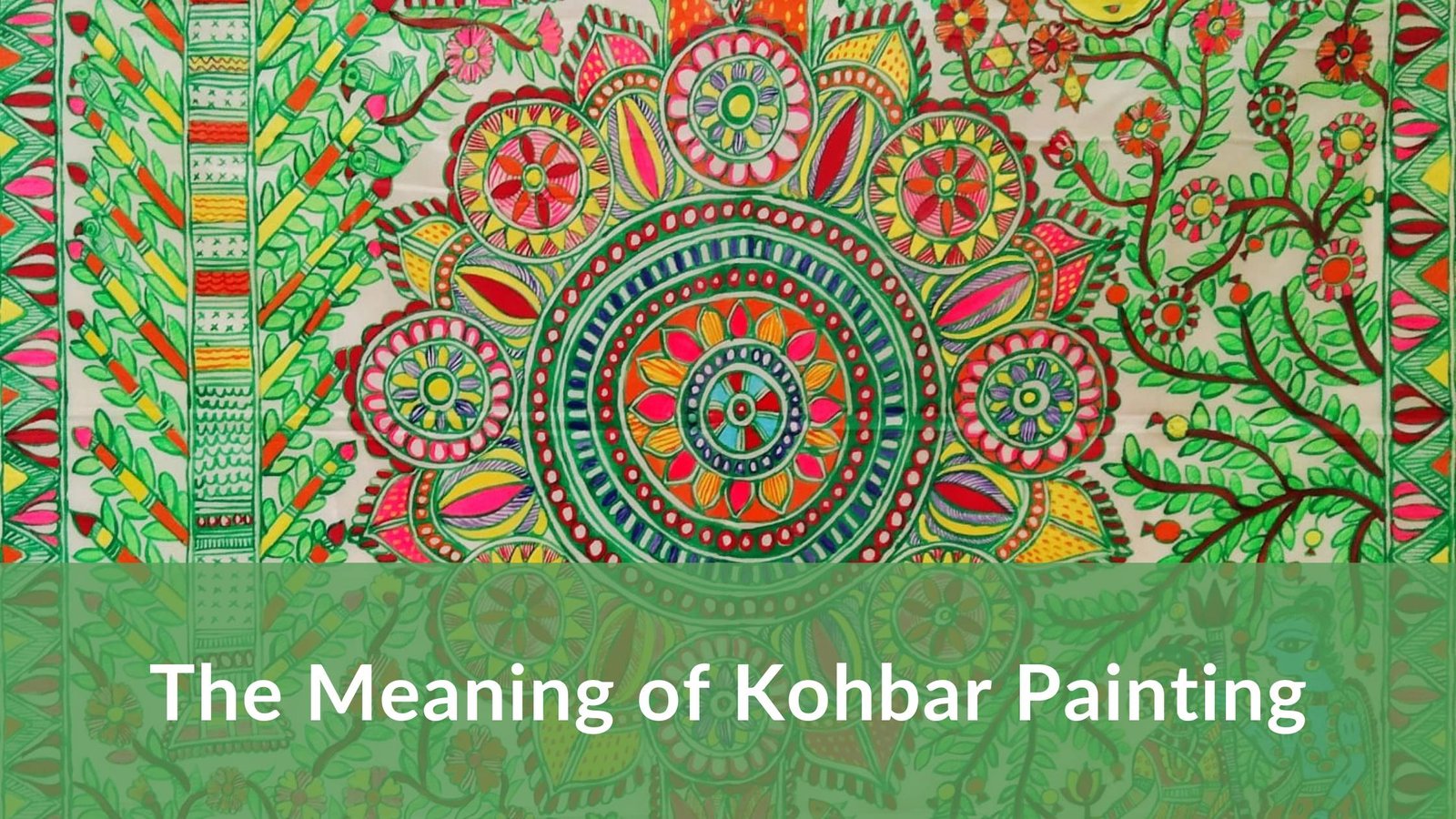
Weddings in India are as much an artistic celebration as they are cultural, with every detail holding deep significance. In Mithila, the tradition of Madhubani paintings takes center stage during these occasions, infusing these ceremonies with both beauty and profound meaning.
Madhubani paintings are believed to have originated during the reign of King Janak, who commissioned artists to adorn his palace walls for the wedding of his daughter, Devi Sita, to Lord Rama. This ancient tradition continues to be an essential part of Mithila weddings today.
In this blog, we’ll explore the kohbar style of Madhubani painting, a significant element in Maithil wedding rituals, where its rich symbolism and vibrant colors bless the union of the couple.
What is Kohbar Painting?
The ‘kohbar’ or ‘puren’ style is a variant of Madhubani art, along with Kachni, Bharni, Godna, and Tantric styles. Kohbar painting holds great ritualistic importance as it serves as an auspicious decoration for the bride’s chamber (kohbar ghar) during wedding ceremonies. This space is the most vibrantly painted part of the bridal home, setting the tone for the newlyweds’ first four nights together, where they begin their married life.
The imagery in these paintings is rich with symbols of fertility, abundance, and love, each element carefully chosen to bring blessings and prosperity to the couple’s new journey. Created with love by the women of the household, Kohbar paintings are characterized by bright colors, intricate geometric patterns, and vivid depictions of religious symbolism and marriage rituals.
These Maithil artworks serve not only as beautiful decorations but also as powerful symbols of the couple’s fresh beginnings and the promise of a harmonious and fruitful life together.
Every element in a kohbar painting carries deep symbolic meaning, reflecting the beliefs and values of the Mithila community. The motifs often draw inspiration from nature, local landscapes, and religious symbols.
Let’s take a closer look at the key elements found in a kohbar design.
Themes & Symbolism in Mithila Kohbar Paintings
Symbolizing a fruitful union and serving as a totem of protection against negative energies, kohbar paintings adhere to traditional iconography. Here are some of the most common symbols featured in these vibrant artworks.
The Central Motif
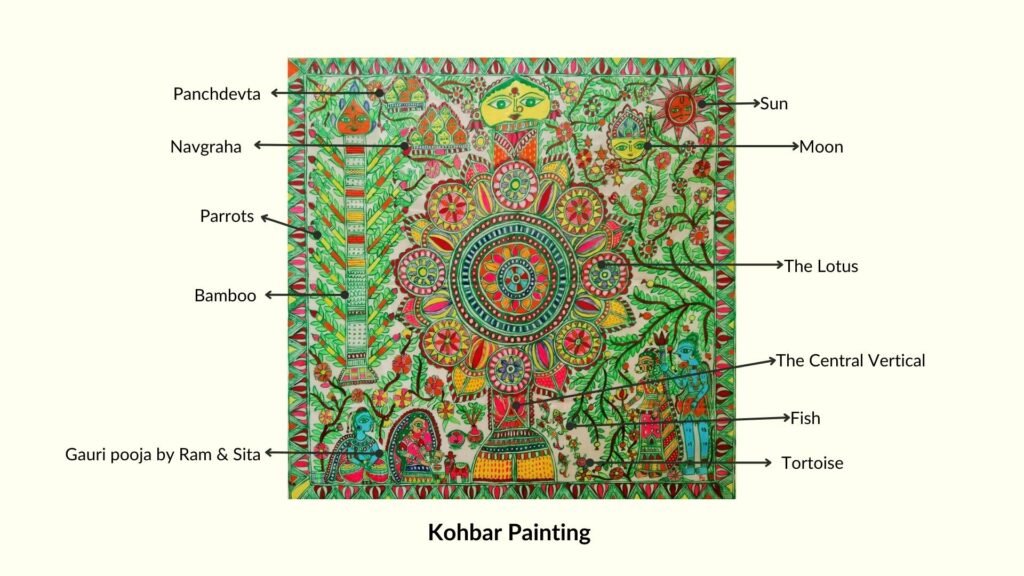
In most kohbar paintings, the sacred union of the bride and groom is depicted by the central motif. It consists of the following elements:
1. The Lotus
A lotus in the centre is the dominant image of a traditional Mithila kohbar painting. The leaves, roots, and stems of the lotus weave a complex, elaborate pattern. This represents the belief that the bride will flourish, much like the blooming lotus. Symbolizing fertility and abundance, the lotus is also a powerful emblem of purity, beauty, and enlightenment.
2. The Central Vertical
This vertical shape, resembling a phallus, is seen as the male counterpart in the painting, signifying strength and fertility. It is often depicted piercing through the central ring of the lotus, anchoring the painting’s central theme.
3. The Bamboo Grove
A dense bamboo grove is incorporated as a metaphor for multiplying lineage. Bamboo grows quickly and continually, symbolizing a blessing for a long, thriving marriage.
Interpretations
Depending on the tradition, the depiction varies: some caste-based versions, such as the Kayastha style, feature faces inside the rings of the lotus, while others, like the Brahmin version, incorporate intricate patterns and designs.
These symbols are open to interpretation. For some, the central elongated figure may be seen as a phallic symbol, while others interpret the lotus as a representation of the female and the bamboo grove as a symbol of the male, signifying growth and fertility.
Alternatively, some researchers suggest a simpler interpretation: the kohbar painting can be seen as an homage to Lakshmi, with the lotus symbolizing feminine power and the promise of good fortune.
Symbols of Abundance
Madhubani paintings, deeply rooted in the elements of nature, are adorned with a variety of flora and fauna. The kohbar style, too, incorporates various plant and animal motifs, each symbolizing different aspects of life, fertility, and prosperity—all designed to bless the newlyweds.
Fauna in Kohbar Paintings
- Fish: A symbol of fertility, the fish is revered for its high breeding potential, making it an auspicious sign of marital prosperity. A pair of fish represents the harmony and compatibility between the bride and groom.
- Tortoise: Associated with longevity and resilience, the tortoise symbolizes a lasting and steadfast marriage. It encourages the couple to develop patience and adaptability in their journey together.
- Snakes: Snakes represent divinity and passionate love, and they are believed to bring protection and strength to the union.
- Birds: Green parrots and peacocks, often depicted in pairs, symbolize love, fertility, and procreation, reinforcing the themes of companionship and harmony.
Flora & Natural Elements
- Trees and Flowers: Betel leaves, an important part of Maithil tradition, signify respect, auspicious beginnings, and good fortune. They are also linked to sacred offerings made to deities. The flower garden in kohbar paintings represents the first meeting of Ram and Sita in Pushpavatika, a moment of divine romance.
- Divine Celestial Bodies: The sun, moon, stars, and the Navagrahas (nine auspicious planets) are frequently depicted as celestial witnesses to the sacred marriage. They are believed to bless the couple with cosmic harmony. The Tulsi plant, symbolizing Goddess Lakshmi, represents purity and prosperity.
Deities & Mythological Figures
Several divine figures are painted as sacred witnesses to the couple’s union.
- Panchadevta (five major deities) and Krishna playing the flute for Radha symbolize eternal love.
- The Nandi bull, associated with Lord Shiva, represents sexual vitality and fertility.
- Shiva and Parvati bestow their blessings, while Ram and Sita performing Gauri Pooja reinforce marital sanctity.
- In some depictions, Sasthi, the goddess of childbirth, is painted to bless the couple with offspring.
Since the Maithili community does not traditionally follow horoscope matching, these divine elements signify celestial approval of the marriage.
Wedding Scenes & Rituals
The kohbar often illustrates key moments from a Maithil wedding:
- The groom’s grand arrival on an elephant.
- The bride seated in a traditional palanquin.
- The wedding ceremony itself.
- The emotional farewell (bidaai) as the bride departs for her new home.
These scenes add a narrative layer to the painting, visually chronicling the sacred rites of a Mithila wedding.
Geometric Patterns & Ornate Borders
Geometric motifs in kohbar paintings symbolize order, balance, and harmony. Fine lines and intricate patterns fill negative spaces, ensuring the artwork appears dense and vibrant. Flora and fauna are used to embellish borders, enhancing the decorative appeal while maintaining symbolic depth.
Rituals & Process of Decorating the Kohbar Ghar
The kohbar ghar, or the bridal chamber, holds deep cultural and spiritual significance in Mithila weddings. Its decoration follows a sacred, time-honored process, blending artistry with ritual to bless the newlyweds with prosperity, fertility, and harmony.
Traditional Preparation of the Wall
The central wall of the bridal chamber is first coated with a mixture of mud and cow dung. This natural layer not only strengthens and preserves the surface but is also considered highly auspicious, believed to bring prosperity to the couple.
At the heart of the wall, a vermillion dot (sindoor bindi) is placed, marking the focal point of the composition. This sacred center serves as the foundation upon which the kohbar painting unfolds.
Painting the Kohbar
Once the base is ready, the kohbar is meticulously painted using powdered rice paste and natural pigments derived from flowers, leaves, soot, and ochre. Traditional tools such as fingers, bamboo brushes, cotton rags, and even handcrafted pens are used for the artwork.
The figures in the kohbar are drawn in a ritualized sequence:
- The head is painted first.
- Then, the upper body is formed.
- The lower body follows.
- Finally, the eyes are drawn.
This sacred method is meant to summon the divine powers to bless the marital union.
Modern Adaptations
In contemporary times, the kohbar is often painted on silk cloth or canvas paper instead of directly on the wall. These artworks are then affixed to the kohbar ghar as decorative elements.
Additionally, modern materials such as acrylic paints, synthetic brushes, digital prints, and new motifs—including calligraphic blessings like Saubhagyavati Bhava (May you be blessed with a fortunate marriage)—have found their place in the evolving tradition.
Sacred Elements of the Kohbar Ghar
- The four corners of the bridal room are adorned with images of four-eyed goddesses (Naina-Yoginis), divine guardians who play a vital role in the wedding rituals.
- A central pot with a sacred lamp is placed in front of the kohbar painting, symbolizing prosperity and divine presence.
- A clay elephant, representing strength and stability, is positioned nearby.
Rituals in the Kohbar Ghar
- The bride and groom perform Gauri Pooja before the kohbar for four days, seeking blessings from Goddess Parvati for a harmonious married life.
- Each evening, the bride lights the sacred lamp, and traditional kohbar geet (folk wedding songs) are sung.
- On the fourth day, the final wedding rituals take place within the kohbar ghar, marking the formal beginning of the couple’s lifelong union.
A Timeless Expression
The kohbar painting is much more than an artistic tradition. It is a sacred expression of love, fertility, and divine blessings, deeply rooted in Mithila culture. From its careful creation using natural materials to its profound symbolism, every element is designed to invoke prosperity and harmony in the marital journey.
While modern adaptations have introduced new materials and techniques, the essence of the kohbar remains unchanged, a timeless testament to the hopes, prayers, and traditions that bind families together.
As this heritage continues to evolve, it carries forward the legacy of Mithila’s artistic and spiritual richness, ensuring that each marriage begins with a canvas of beauty, devotion, and auspicious blessings.