

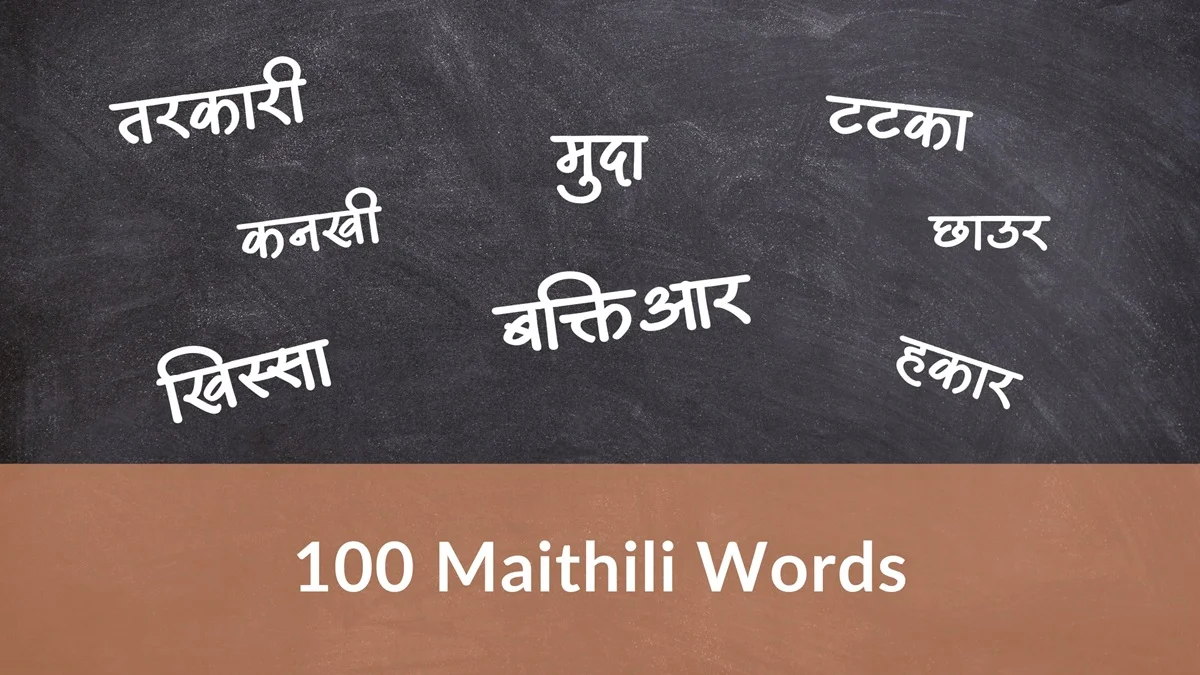
Maithili is spoken by millions across the Indian state of Bihar and beyond. While it shares roots with the more widely known Hindi, Maithili’s unique vocabulary offers a fascinating window into the traditions, values, and daily experiences of the Maithili-speaking community.
In this blog post, we’ll look at some common Maithili words and their meanings. Whether you’re a Maithili speaker or just interested in languages, you’re sure to find these words interesting.
Before we immerse ourselves in the vibrant Maithili vocabulary, it’s important to understand the diverse linguistic influences that have shaped this language over time.
Let’s take a brief look at the origins of the Maithili language’s words, setting the stage for our deeper exploration ahead.
The Origins of Maithili Words
Like many Indo-Aryan languages of the Indian subcontinent, Maithili’s vocabulary has been shaped by a variety of linguistic influences over the centuries. While Sanskrit provides a foundational layer, the language has also absorbed elements from a variety of other sources:
- Prakrit Dialects: As Sanskrit evolved into more vernacular forms, Maithili embraced words from Prakrit languages, such as the regionally influential Magadhi Prakrit.
- Pali: The liturgical language of Theravada Buddhism, Pali, has also left its mark on Maithili, contributing spiritual and philosophical terms.
- Apabhramsa: The transitional medieval forms of language that bridged classical Sanskrit and modern Indo-Aryan, like Apabhramsa, have added nuance and complexity to the Maithili lexicon.
- Neighboring Tongues: Given Maithili’s geographic proximity to Bhojpuri and Bengali, it has naturally absorbed linguistic elements from these closely related languages as well.
This mix of influences has given Maithili a unique richness and diversity. It offers a special window into the cultural traditions and values of the Maithili-speaking communities.
100 Common Maithili Words and Their Meanings
Now, let’s dive into a curated selection of 100 Maithili words that encapsulate the essence of this remarkable language. Each one gives us a glimpse into the Maithili way of life.
Communication
- केहन (Kehan) – How
- किम्हर (Kimhar) – Where
- कहिया (Kahiya) – When
- किए (Kiae) – Why
- कि (Ki) – What
- अहाँ (Ahan) – You (formal)
- हम (Ham) – I, we
- बुझलऊं (Bujhlaun) – Understood (formal)
- मुदा (Muda) – But
- जखन (Jakhan) – Of which time
- तखन (Takhan) – On that moment
- लगले (Lagle) – Immediately
- मुहा-मुही (Muha-muhi) – Face-to-face
Emotions & Expressions
- नोर (Nor) – Tears
- उत्किरना (Utkirna) – Praise
- नीक (Neek) – Good/nice
- अकच्छ (Akacch) – Annoyed
- कनखी (Kankhi) – Side glance
- मुस्की (Muski) – Smile
- मोन (Mon) – Wish/desire
Family & Relationships
- कनिया (Kaniya) – Bride, wife
- बौर (Baur) – Groom, husband
- संगी (Sangi) – Friend
- बहीन (Bahin) – Sister
- भैए (Bhae) – Brother
Nature & Environment
- रउद (Raud) – Sunlight
- गाछ (Gaach) – Tree
- तरकारी (Tarkari) – Vegetable
- अन्हार (Anhaar) – Darkness
- इजोत (Ijot) – Light
- बेर (Ber) – Time
- भोर (Bhor) – Morning
- सांझ (Saanjh) – Evening
- फरीछ (Pharichh) – Light/clear
Food & Cuisine
- खेनाइ (Khenai) – Food
- भात (Bhaat) – Cooked rice
- भोज (Bhoj) – Feast
- भानस (Bhanas) – Cooking
- भनसिया (Bhansiya) – Cook
- भनसा घर (Bhansa ghar) – Kitchen
Plants & Animals
- बानर (Banar) – Monkey
- महीख (Maheekh) – Buffalo
- मूस (Mus) – Rat/mole
- सपनौर (Sapnaur) – Mongoose
- कटहर (Kathar) – Jackfruit
- कदीमा (Kadima) – Pumpkin
- मखान (Makhan) – Foxnut
- सजमइन (Sajmain) – Bottle gourd
- माछ (Maach) – Fish
- लजबिज्जी (Lajbijji) – Touch-me-not plant
- लत्ती (Latti) – Creeper
Objects & Items
- थारी (Thaari) – Plate
- बाटी (Baati) – Bowl
- केवारी (Kevari) – Door
- इनार (Inaar) – Well
- नूआ (Nua) – Saree/Dhoti
- टका (Taka) – Money
- लई (Lai) – Adhesive
- लहठी (Lahthi) – bangles made of lac
- छाउर (Chhaur) – Ashes
- झोल (Jhol) – Spider’s web blackened with smoke and dust
- धधरा (Dhadhra) – Flame
Body Parts
- कलेबर (Kalebar) – Body/stature
- मूड़ी (Mudi) – Head
- गोड़ (Gor) – Feet
- ठेहुन (Thehun) – Knee
Adjectives
- काजुल (Kajul) – Active
- लजकोटर (Lajkotar) – Shy/coy
- लबरा (Labra) – Liar/talker (Male)
- हहास (Hahas) – Wrath
- हाफी (Haphi) – Yawn
- हरारत (Hararat) – Fatigue
- हरखित (Harkhit) – Glad
- हेहर (Hehar) – Impudent
- थेत्थर (Thetthar) – Shameless
- थोका (Thoka) – Bunch
- फोंफ (Phonph) – Snore
- बक्तिआर (Baktiar) – Increase, prosperity
- बखरा (Bakhra) – Share
- बताह (Batah) – Mad
- छरहर (Charhar) – Slim
- लहालोट (Lahalot) – Overjoyed
- लरगुज (Larguj) – Limp
- छिछराह (Chhichrah) – Slippery
- टनकी (Tanki) – Intermittent aching
- फाटल (Phatal) – Torn
- टटका (Tatka) – Recent, latest/fresh
- जनमउटी (Janmauti) – Newborn
- चरफर (Charphar) – Clever
- एहन (Ehan) – Almost similar to this
- अनमन (An-man) – Exactly
- भकचक (Bhakchak) – Astonishment
Miscellaneous
- काज (Kaaj) – Work
- मोलाई (Molai) – Bargain
- सनेस (Sanes) – Gift/present, message
- फकरा (Phakra) – Child’s play rhyme
- हकार (Hakar) – Invitation
- हुल्की (Hulki) – Peep
- खिस्सा (Khissa) – Story
- पावएन (Pavain) – Festival
More to Explore!
Through these 100 Maithili words, we’ve stepped into the heart of a language rich with history, emotion, and cultural nuances. Each word tells its own story, from the practicalities of everyday life to the warmth of family connections, the beauty of nature, and the depth of human expression.
Whether you’re brushing up on your Maithili or getting acquainted with it for the first time, we hope these words bring you closer to the beauty and richness of Maithili.
Stay tuned for more such exhilarating explorations of the Maithili language!