
There’s a particular kind of tired that doesn’t go away with sleep. It’s the tired that comes from being switched on all day… replying, deciding, scrolling, planning the next thing before the current thing is even done.
You don’t need another wellness app for that. You need something small and absorbing enough to actually quiet your mind, with your phone face-down for thirty minutes.
This is exactly what Madhubani coloring pages for adults are for. You’re not learning a skill or ticking off a productive-downtime box. You’re just coloring in a pattern, in silence, using one of the most detailed and meditative art forms India has to offer.
Why coloring pages actually calm you down
Coloring is one of the best stress-relief tools. It gives your mind one small thing to focus on instead of ten.
Most days, our brain is bouncing between unfinished tasks, conversations, notifications, and everything we still need to remember. But when you’re coloring, none of that matters for a little while.
You’re not thinking about that email you forgot to reply to. You’re deciding whether the peacock’s feathers should be teal or green. That’s the only decision you need to make in that moment.
And there’s something incredibly calming about that.
It’s one of the reasons adult coloring books became so popular. The simple, repetitive act of filling a page gives your mind a break from constant mental chatter. It feels mindful without trying too hard. No pressure to clear your mind. No pressure to do it perfectly. Just a few quiet moments where your attention rests on one small, beautiful thing.
Why Madhubani coloring pages work even better
Not all coloring sheets are made the same. Generic mandalas and doodle-book pages are good, but Madhubani art brings something extra to the table, and it’s the reason Madhubani coloring pages for adults have such a devoted following.
The detail keeps you in the moment longer.
In Madhubani art, empty space is considered incomplete. Every inch gets filled. Fish scales, lotus petals, tiny dots, and fine lines running into each other. That density is exactly what makes it so absorbing to color. There’s always a next small space to fill, which is what keeps your hands moving and your mind still for longer than a simpler pattern ever could.
The motifs carry meaning, not just pattern.
A pair of fish for togetherness. A peacock for grace. A lotus rising clean out of muddy water. You’re not just filling in shapes. You’re coloring in symbols that Indian households have leaned on for generations to represent the good things in life.
It’s a form of quiet cultural reconnection.
These patterns have been passed down through generations of women in Mithila, painted on mud walls and courtyard floors long before they ever made it to paper. When you color one in, you’re spending those quiet minutes inside a tradition that’s still being carried forward today.
For a lot of us who grew up with some distance from that heritage (maybe you’ve seen Madhubani art on a saree border or at a relative’s house, but never really sat with it), a coloring sheet is a small, low-pressure way back in.
It’s the same relaxing motion as any coloring page, with the added layer of coloring inside a tradition you may already feel connected to.
You don’t need to be “good at art” for this
This is the part people get wrong before they try it.
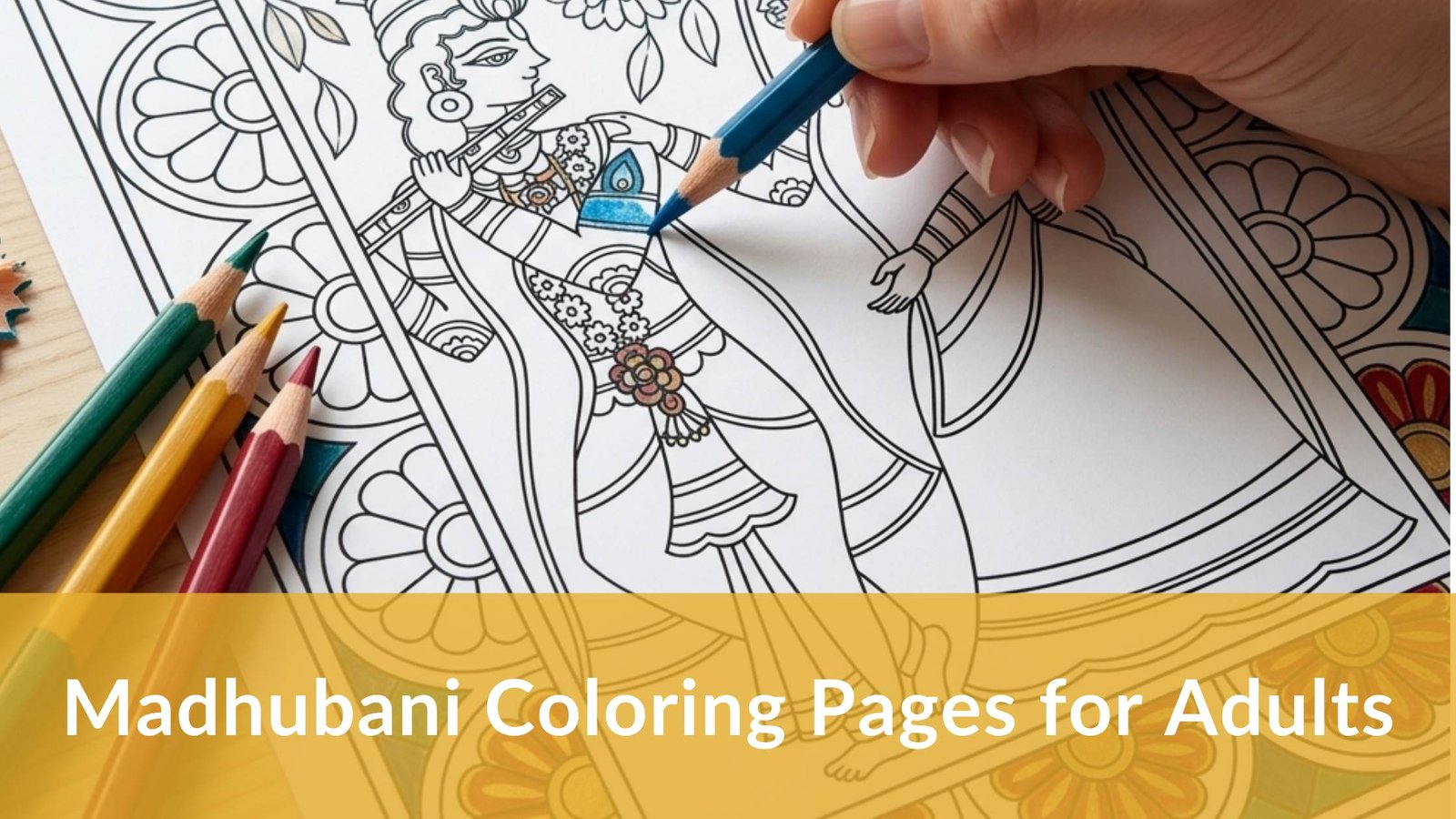
Madhubani printable coloring sheets don’t ask precision. The outlines are already there, hand-drawn and waiting for you. Your only job is to pick colors and fill them in. There’s no wrong way to color a lotus pond. Some people go with the traditional palette of red, yellow, and black. Others go rogue with pastels or metallics. Both are right.
If you’ve ever hesitated to try Madhubani painting because it looks intricate and “expert,” a coloring sheet is the gentlest possible entry point. You get all the meditative, pattern-filling satisfaction, with zero pressure to draw a single line yourself.
How to get started with Madhubani coloring pages
You need almost nothing to begin. Here’s the simplest way in:
- Pick one design. Don’t overthink it. A single motif like a fish or lotus is the easiest place to start if this is your first Madhubani printable.
- Print it at home. Regular printer paper works fine for your first few tries. If you plan to frame the finished piece later, slightly thicker paper (180-200 gsm) holds color better and feels nicer to work on.
- Choose your medium. Colored pencils are the most forgiving for beginners. Poster colors or watercolors give a more traditional, painted finish once you’re comfortable.
- Start from the border, and work inward. This mirrors how Madhubani art is traditionally filled in and keeps you from feeling overwhelmed by the detail.
- Set a timer for thirty minutes, and nothing else. No phone, no multitasking. Let the pattern be the only thing you’re doing.
That’s genuinely the whole process. No class, no supplies list longer than “pencils and paper.”
Ways to make it an actual ritual, not a one-off download
- Sunday wind-down: Coffee, a coloring sheet, twenty minutes before the week starts again.
- With your evening chai: Instead of picking up your phone the moment you sit down.
- As a shared activity: Print two copies and color alongside your daughter, your mother, or a friend — no talking required, just company.
- Frame it after: A lot of our customers color their finished sheet and frame it. What started as a stress-relief break ends up as art on the wall.
What makes Madhubani coloring pages worth choosing
| Madhubani coloring pages | Mandala / floral coloring books | |
|---|---|---|
| Pattern style | Traditional Indian motifs – fish, peacock, lotus, tree of life | Geometric or floral patterns, often abstract |
| Symbolism | Each motif carries meaning passed down through generations — a fish pair for togetherness, a lotus for renewal | Can carry meaning too, depending on the design, though many are drawn purely for visual rhythm |
| Cultural roots | Tied to a specific, living art tradition from Mithila, Bihar, still practiced by artisans today | Some styles, like mandalas, also carry deep cultural or spiritual roots of their own, just from different traditions |
| Skill level needed | None, outlines are ready to fill in | None, outlines are ready to fill in |
| What you can do after | Color it, frame it, or use it as a first step into learning Madhubani painting | Color it and keep it, or use it the same way |
Both are genuinely good ways to unwind. The real difference is which tradition you want to spend your twenty minutes inside, and if it’s one rooted in Indian art and stitched into your own cultural memory, Madhubani is hard to beat.
What you’ll find in our printable collection
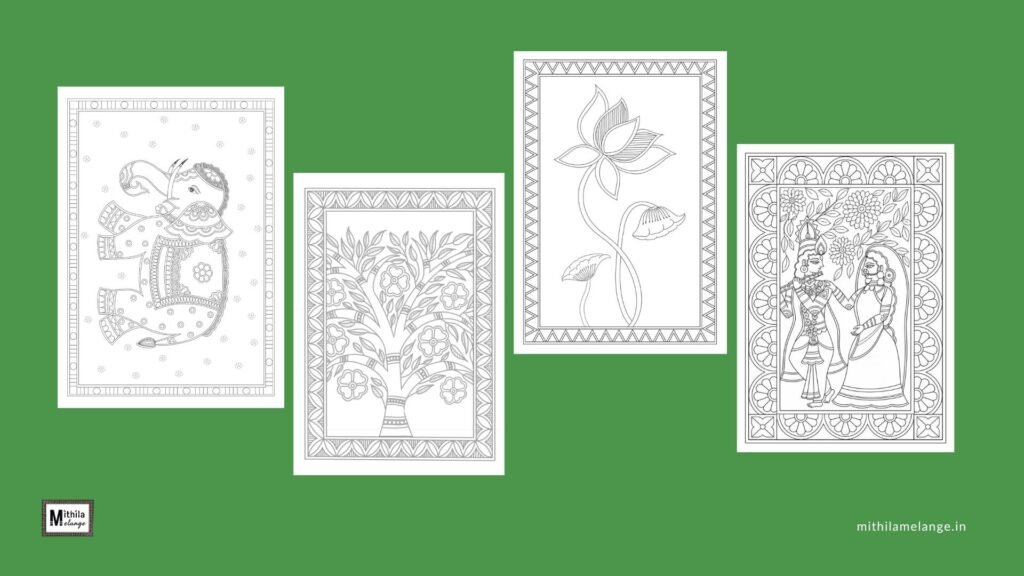
We currently have a small, growing set of Madhubani printable coloring sheets — Indian art coloring sheets designed to be printed at home, with no special paper or tools required:
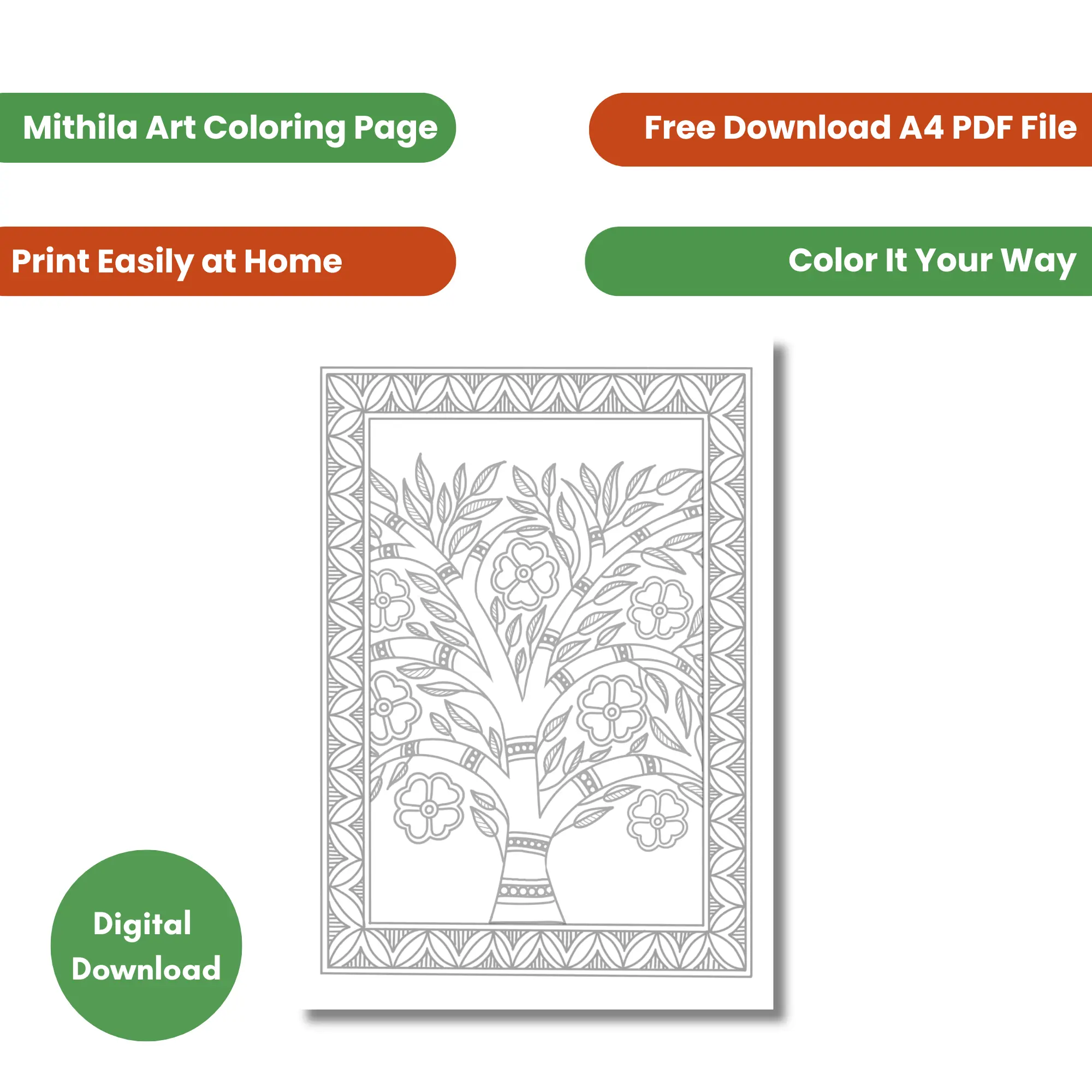
- A free Madhubani tree coloring sheet to start with. It’s no commitment, just print and color.
- A set of Madhubani coloring pages featuring peacock, elephant, and lotus designs, for when you want variety.
- A Radha Krishna in the garden coloring page, if you’d like something with a little more story in the scene.
- An extensive set of easy-to-advanced Madhubani painting designs when you want to go deeper.
- A Madhubani border design practice sheets set, if you want to start with the borders.
Each one is an instant digital download. You print it at home, and you’re coloring within minutes.
FAQs
Are these Madhubani coloring pages authentic designs?
Yes. Every printable is based on genuine Madhubani motifs and composition. Fish, peacocks, lotus ponds, the tree of life, all these are the same visual language used in traditional Mithila art.
Do I need any special art supplies?
No. Colored pencils work beautifully on these sheets and are the easiest to start with. Poster colors or watercolors also work well if you want a more traditional finish, but they’re not required.
What paper should I print the Madhubani printable on?
Regular printer paper is fine for your first few tries. If you plan to frame the finished piece, printing on slightly thicker paper (180-200 gsm) gives a nicer result and holds color better.
Is this suitable for beginners with no art background?
Completely. The outlines are already drawn for you. All you’re doing is choosing colors and filling them in. There’s no drawing skill required.
How is this different from other Indian art coloring sheets online?
Ours are illustrated specifically for adult colorists, with the intricate, every-space-filled detail that makes Madhubani art so absorbing to work on, not simplified kids’ outlines.
Can I use these with my kids too?
Yes, though our printable sheets are designed with adult colorists in mind, slightly more intricate detail than a typical kids’ coloring page. Older kids and teens usually enjoy them too.
How long does one coloring page usually take?
Anywhere from 20 minutes for a single small motif to a couple of hours for a fuller composition. There’s no “finish line” to rush toward. You can stop and pick it back up anytime.
Ready to color your way to calm?
Start with our free Madhubani tree coloring sheet. Download it, print it, and see how it feels to spend twenty unhurried minutes with a pattern instead of a screen.
Download the free coloring sheet →
Browse the full printable collection →
And if coloring it in yourself isn’t quite your thing but you love how it looks finished, we get it. Our handcrafted Madhubani collection brings the same motifs to life on coasters, trays, and decor pieces, already colored in by the artisans who’ve been painting them for generations.