
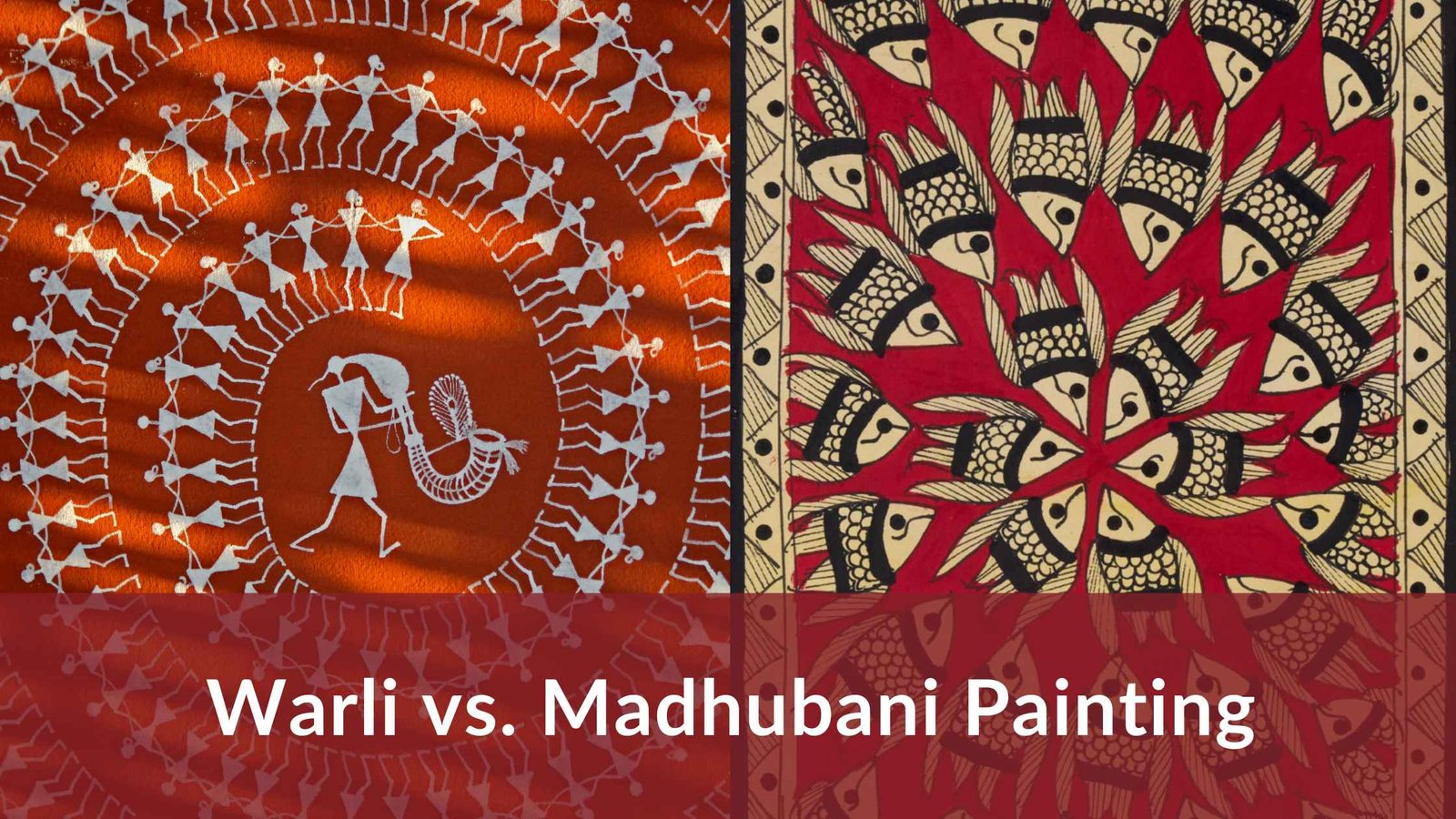
At first glance, Warli painting and Madhubani painting can look surprisingly similar. Both are traditional Indian art forms centered on community life, nature, rituals, and storytelling. Both use stylized figures, geometric shapes, repeated patterns, and decorative elements rather than realistic representation.
So it is easy to mistake one for the other.
But if you look more closely, the differences become clear. Warli painting is known for its minimalist geometric language, white figures, and earthy backgrounds, while Madhubani painting is recognized for vibrant colors, intricate patterns, bold outlines, and symbolic imagery.
Both are important traditions in Indian art, but they come from different regions and communities and have developed distinct ways of representing people, nature, stories, and beliefs.
In this guide, we’ll explore the similarities and differences between Warli and Madhubani painting, including their origins, colors, figures, motifs, patterns, borders, themes, and techniques.
Warli Painting vs. Madhubani Painting at a Glance
| Feature | Warli Painting | Madhubani Painting |
| Origin | Maharashtra | Mithila region of Bihar |
| Community | Warli community | Mithila communities |
| Visual style | Minimalist and geometric | Intricate and decorative |
| Traditional colours | White on an earthy background | Vibrant, contrasting colours |
| Human figures | Built from simple geometric shapes | Stylized figures with expressive eyes and details |
| Background | Relatively open and simple | Often densely filled with patterns and motifs |
| Borders | Geometric, repetitive, rhythmic | Elaborate, floral, geometric and symbolic |
| Common themes | Village life, farming, hunting, rituals, nature | Mythology, deities, marriage, fertility, nature and social life |
| Signature imagery | Tarpa dance, village scenes | Fish, lotus, peacock, deities, Kohbar imagery |
| Traditional surfaces | Mud walls | Mud walls and floors |
| Overall impression | Simple, rhythmic and graphic | Rich, colorful and intricate |
The easiest way to remember the difference is:
Warli creates visual storytelling through simplicity. Madhubani creates visual storytelling through detail.
But there is much more to the distinction.
Why Are Warli and Madhubani Paintings Often Confused?
Before looking at their differences, let’s understand why the two art forms can look alike.
Both Warli and Madhubani paintings share several traits because both:
- Developed within traditional Indian communities.
- Have strong connections with nature and everyday life.
- Have ritual and cultural significance.
- Use stylized, two-dimensional figures.
- Incorporate geometric shapes and repeated patterns.
- Use art as a way of telling stories.
- Traditionally made use of locally available materials.
- Were traditionally created on walls and other domestic surfaces.
- Have evolved into contemporary forms on paper, canvas, textiles, wood, and other surfaces.
These similarities can make them seem related at first glance.
However, these are broad characteristics shared by many Indian folk and traditional art forms. The visual vocabulary, symbolism, composition, and cultural context of Warli and Madhubani are quite different.
Where Did Warli Painting Originate?
Warli painting is a traditional art form associated with the Warli community of Maharashtra.
Historically, Warli paintings were created on mud walls, particularly around important occasions and rituals. The earthy wall provided the background, while white pigment made from rice paste was used to create the figures and patterns.
The art reflects the Warli community’s close relationship with its surroundings. Forests, animals, farming, village activities, seasons, rituals, and community celebrations frequently appear in the paintings.
Rather than attempting to reproduce the world realistically, Warli artists developed a remarkably economical visual language. A few geometric shapes and lines can represent people, animals, trees, houses, tools, and entire community scenes.
This simplicity is one of the defining characteristics of Warli art.
Where Did Madhubani Painting Originate?
Madhubani painting, also known as Mithila painting, originated in the Mithila region of Bihar.
Traditionally, people created these paintings on the walls and floors of homes, especially during weddings, festivals, religious occasions, and other important events.
Over time, Madhubani painting expanded onto paper, cloth, canvas, wood, and many other surfaces. Different styles also developed within the broader Madhubani tradition, including Bharni, Kachni, Godna, Tantrik, and Kohbar.
Madhubani art is particularly known for its bold outlines, vibrant colors, intricate patterns, symbolic motifs, and richly filled compositions.
While everyday life and nature are important subjects, mythology and religious imagery also play a significant role.
Warli vs. Madhubani: The Biggest Visual Difference
The most obvious difference between the two is their visual language.
Warli: Simplicity Through Geometry
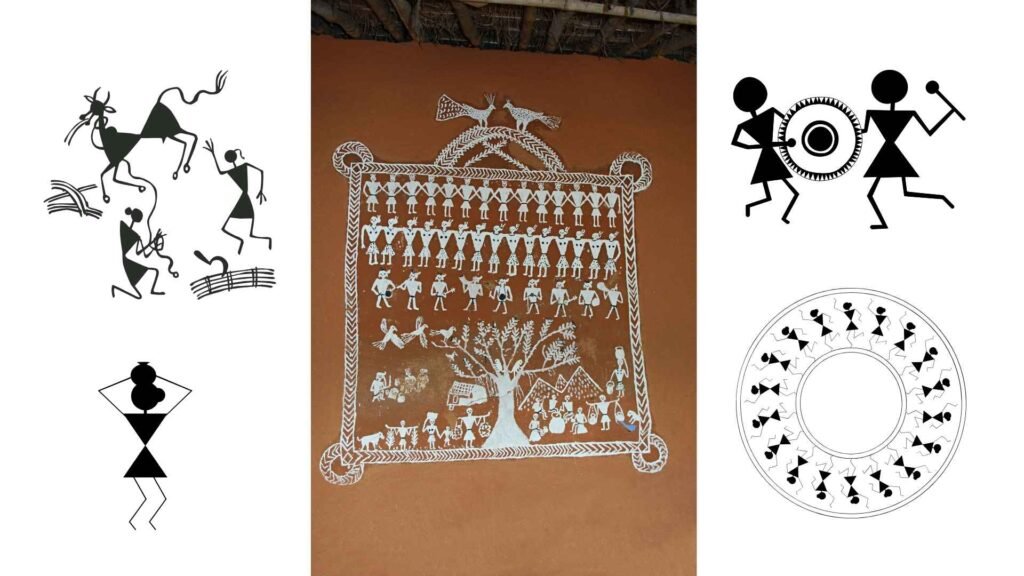
Warli painting uses a relatively limited set of shapes:
- Circles
- Triangles
- Squares
- Lines
- Dots
- Simple geometric patterns
These shapes aren’t simply decorative. They help construct the subjects themselves.
For example, the characteristic Warli human figure is made using two joined triangles, with simple lines and circles forming the limbs and head.
Despite this minimal vocabulary, Warli paintings can tell remarkably detailed stories about village life.
Madhubani: Detail Through Pattern
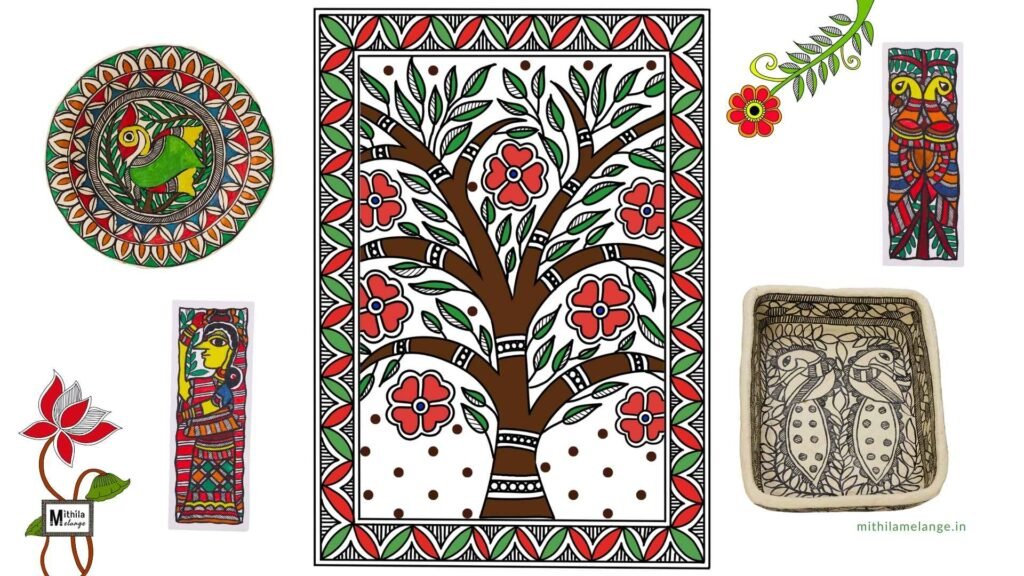
Madhubani painting also uses geometric shapes, but they play a different role.
Circles, triangles, dots, lines, stripes, spirals, and other patterns are often used to structure and decorate the composition. Figures are surrounded by intricate details, while empty spaces may be filled with flowers, leaves, birds, fish, vines, or geometric designs.
Bold outlines, hatching, cross-hatching, stippling, and repeated patterns add further texture.
So, while both use geometry, in Warli, geometry often creates the subject. In Madhubani, geometry often enriches the subject.
Warli vs. Madhubani Human Figures
Human figures are one of the easiest ways to distinguish the two traditions.
Human Figures in Warli Painting
Warli figures are highly stylized and geometric. A typical figure consists of:
- A circular head
- Two joined triangles forming the body
- Simple lines for arms and legs
- Minimal facial detail
The figures often appear in groups farming, dancing, hunting, fishing, cooking, celebrating, or participating in rituals.
Their simplicity makes the overall movement of the scene more important than individual facial characteristics.
Human Figures in Madhubani Painting
Madhubani figures tend to be more elaborate. They are characterized by:
- Bold outlines
- Prominent, expressive eyes
- More detailed faces
- Decorative clothing and body details
- Intricate patterns surrounding or filling the figures
When depicting Hindu deities, Madhubani artists often give particular attention to facial features, ornaments, clothing, and symbolic attributes.
This creates a much more visually dense appearance than the typical Warli figure.
Borders in Warli vs. Madhubani Painting
Borders are another interesting similarity between Warli and Madhubani painting. Both traditions use borders to frame compositions and add rhythm, but the treatment is quite different.
Warli Painting Borders
Warli borders generally draw from the same simple geometric vocabulary as the rest of the painting. You may find:
- Rows of triangles
- Dots
- Dashes
- Repeated geometric shapes
- Simple plant forms
- Rhythmic linear patterns
The border tends to reinforce Warli’s minimalist and geometric character.
Madhubani Painting Borders
Madhubani borders can be considerably more elaborate. They may incorporate:
Multiple bands of patterns may also be combined to create a decorative frame.
And the decoration doesn’t necessarily stop at the border. One defining characteristic of Madhubani painting is its tendency to fill the interior space as well, leaving little empty background.
The Key Difference
Warli borders extend the painting’s geometric rhythm, while Madhubani borders become additional space for ornamentation, pattern, and symbolism.
This is one reason the two art forms may look similar from a distance but very different up close.
Colors: Warli’s Earthy Contrast vs. Madhubani’s Vibrancy
Color is perhaps one of the quickest visual clues.
Traditional Warli Colors
Traditional Warli painting is strongly associated with white pigment and a reddish-brown or mud-colored background.
Artists traditionally made the white pigment from rice paste mixed with water and a binding material. The background came from mud and other natural materials used to prepare the wall.
This restrained palette gives Warli its distinctive graphic quality.
Madhubani Colors
Madhubani paintings are generally much more colorful. Common colors include:
- Red
- Yellow
- Green
- Blue
- Pink
- Orange
- Black
- White
Traditional artists used natural pigments derived from materials such as plants, flowers, minerals, soot, turmeric, indigo, and rice powder.
Different Madhubani styles can use color differently. For example, Bharni is particularly known for areas of solid, bright color, while Kachni relies more heavily on fine line work and hatching.
Contemporary artists have experimented with the color palettes of both traditions. These distinctions are therefore most useful when discussing their traditional visual characteristics.
How Geometric Shapes Work in Warli and Madhubani
Geometry is another feature the two traditions share, but its function differs.
Geometry in Warli Art
Geometric shapes form the foundation of the visual language. Some common associations include:
- Circle: sun, moon, natural movement and cycles of life
- Triangle: mountains, trees, tools and the human body
- Square or chauk: sacred space, ritual enclosure, land or fertility
- Two joined triangles: human or animal figure
- Spiral or circle of dancers: Tarpa dance, community unity and the cycle of life
This gives Warli its instantly recognizable geometric appearance.
Geometry in Madhubani Art
In Madhubani painting, geometric forms are frequently used alongside organic motifs and decorative patterns. They can appear as:
- Borders
- Fillers
- Repeated patterns
- Stripes
- Dots
- Hatching
- Cross-hatching
- Circular and floral designs
Instead of building an entire human figure from basic geometric shapes, Madhubani uses geometry as part of a larger decorative vocabulary.
What Do Warli Paintings Depict?
Warli painting is strongly connected with everyday life and the natural environment. Common subjects include:
- Farming
- Hunting
- Fishing
- Cooking
- Dancing
- Marriage ceremonies
- Village activities
- Animals
- Trees
- Houses
- Community rituals
One of the best-known Warli motifs is the Tarpa dance, where men and women hold hands and dance in a circle or spiral around a musician playing the tarpa, a traditional wind instrument.
This isn’t simply a decorative pattern. It represents movement, togetherness, celebration, and community life. Warli paintings therefore demonstrate how a remarkably small visual vocabulary can communicate an entire story.
What Do Madhubani Paintings Depict?
Madhubani painting has a broader range of mythological, religious, natural, social, and ceremonial subjects. Common themes include:
- Krishna
- Rama
- Shiva
- Durga
- Lakshmi
- Saraswati
- Sun and Moon
- Weddings
- Fertility
- Festivals
- Village life
- Social events
- Nature
- Contemporary social themes
Nature also occupies an important place in Madhubani art. You may frequently encounter:
- Fish
- Lotus
- Peacocks
- Parrots
- Birds
- Elephants
- Snakes
- Trees
- Bamboo
- Vines and flowers
These motifs can carry meanings related to fertility, prosperity, protection, devotion, good fortune, and the relationship between humans and nature.
Want to learn Madhubani painting at home? Read our step-by-step guide.
Nature in Warli and Madhubani Painting
Both traditions have a deep connection with nature, but they often express that relationship differently.
In Warli art, nature frequently forms the environment in which community life takes place. Forests, trees, animals, land, the sun, moon, and seasonal cycles are woven into scenes of everyday activity.
In Madhubani art, nature often becomes a symbolic and decorative vocabulary of its own. Fish, lotus flowers, peacocks, birds, bamboo, trees, and other motifs can fill the composition while also carrying cultural meanings.
Think it like this:
Warli often shows people living within nature. Madhubani often weaves nature into the symbolic fabric of the painting.
Empty Space: Another Important Difference
Look at the background, and you may notice another major difference.
Warli Painting
The earthy background can remain relatively open around individual figures and scenes. The simple composition lets the viewer focus on the geometric figures and their movement.
Madhubani Painting
Madhubani compositions traditionally tend to leave very little space empty. Artists may fill areas with:
- Leaves
- Flowers
- Birds
- Fish
- Vines
- Geometric designs
- Dots
- Lines
- Decorative patterns
This creates the characteristic dense and richly patterned appearance of Madhubani painting.
In simple terms, Warli allows simplicity to breathe. Madhubani often fills the space with life.
Techniques and Traditional Materials
Both art forms traditionally used materials available in their local environments.
Warli
Traditional Warli painting involved:
- Mud-based walls
- Earth and cow dung for preparing the surface
- Rice paste for the white pigment
- Simple tools for applying the paint
The restricted materials contributed to the art form’s distinctive visual simplicity.
Madhubani
Traditional Madhubani artists used a range of tools, including:
- Fingers
- Twigs
- Brushes
- Bamboo tools
- Nib pens
- Matchsticks
Natural pigments were traditionally made from locally available materials.
Today, both traditions are practiced on a much wider range of surfaces and with contemporary materials.
Major Styles Within Madhubani Painting
Another important difference is that Madhubani itself encompasses several distinct styles.
Bharni
Known for solid areas of bright color, often used for deities and mythological figures.
Kachni
Recognized for fine line work, hatching, cross-hatching, and stippling, often with a more limited color palette.
Godna
Characterized by tattoo-like linear patterns and repeated motifs.
Tantrik
Focuses on deities, yantras, and spiritual or esoteric subjects.
Kohbar
Associated with wedding imagery, fertility, lotus flowers, bamboo, and pond life.
This diversity means that not every Madhubani painting will look identical.
How to Identify Warli vs. Madhubani Painting
If you’re trying to identify an artwork at a glance, look for these clues.
It is likely Warli if you see:
- White figures
- An earthy or reddish-brown background
- Two-triangle human figures
- Strong geometric forms
- Minimal facial details
- Village and community scenes
- Tarpa dancers
- Simple geometric borders
- A restrained color palette
It is likely Madhubani if you see:
- Bright, contrasting colours
- Bold or double outlines
- Large expressive eyes
- Dense patterning
- Little empty space
- Elaborate borders
- Fish, lotus, peacocks, birds, or other symbolic motifs
- Hindu deities or mythological scenes
- Extensive floral and geometric decoration
Of course, contemporary artists often experiment with traditional forms, so these clues aren’t absolute rules. They help you understand the traditional visual vocabulary of each art form.
Warli and Madhubani: Similar in Spirit, Different in Language
So, are Warli and Madhubani paintings similar?
Yes, but only up to a point.
They share an important foundation: both are traditional Indian art forms through which communities have expressed their relationship with nature, culture, rituals, beliefs, and everyday life.
But their visual languages differ.
Warli is characterized by:
- Minimalist geometric forms
- White-on-earthy contrast
- Simplified human figures
- Community and everyday-life scenes
- Rhythmic patterns
- Geometric borders
- Strong connections with nature and ritual
Madhubani is characterized by:
- Vibrant colours
- Bold outlines
- Intricate patterns
- Expressive figures
- Mythological and religious themes
- Symbolic natural motifs
- Elaborate borders
- Densely filled compositions
The difference isn’t one being more detailed, colorful, or sophisticated than the other. They simply developed different ways of seeing and representing the world.
Warli demonstrates how much a story can say with a few shapes and lines. Madhubani demonstrates how color, pattern, symbolism, and detail can transform an entire surface into a story.
And perhaps that’s what makes comparing them so fascinating: two different communities, two different visual languages, and two remarkable ways of turning cultural memory into art.
Frequently Asked Questions
Are Warli and Madhubani paintings both folk art?
Yes. Both are important traditional Indian art forms rooted in community and cultural practices. They developed in different regions and communities and have their own distinct visual languages, symbolism, techniques, and traditions.
What is the difference between Warli painting and Madhubani painting?
Warli painting originated among the Warli community of Maharashtra and is known for minimalist geometric figures, white pigment, earthy backgrounds, and scenes of everyday and community life. Madhubani painting originated in the Mithila region of Bihar and is known for vibrant colors, bold outlines, intricate patterns, symbolic motifs, and mythological and social themes.
What are the main characteristics of Warli painting?
Warli painting is characterized by minimalist geometric forms, white pigment on an earthy background, two-dimensional figures, scenes of village and community life, nature-based imagery, ritual themes, and repetitive geometric patterns.
What are the main characteristics of Madhubani painting?
Madhubani painting is known for vibrant colors, bold outlines, intricate line work, geometric patterns, symbolic motifs, expressive eyes, densely filled compositions, and themes drawn from mythology, religion, nature, marriage, fertility, and social life.
Why are Warli and Madhubani paintings often confused?
Warli and Madhubani paintings are often confused because both are traditional Indian art forms that use stylized figures, geometric shapes, repeated patterns, nature-inspired imagery, and storytelling. However, their origins, visual styles, color palettes, motifs, and cultural contexts are different.
How can you tell Warli painting from Madhubani painting?
Look at the color, figures, and level of detail. Traditional Warli paintings typically feature white geometric figures on an earthy background, while Madhubani paintings generally use vibrant colors, bold outlines, expressive eyes, and dense decorative patterns.
Which is more colorful: Warli or Madhubani painting?
Madhubani painting is generally more colorful, with vibrant and contrasting colors used throughout the composition. Traditional Warli painting has a much more restrained palette, most famously using white pigment against an earthy background.
Which is more detailed, Warli or Madhubani painting?
Madhubani painting generally appears more intricate because of its elaborate patterns, detailed line work, decorative borders, and densely filled backgrounds. Warli painting achieves visual richness through simple geometric forms, repetition, rhythm, and storytelling rather than extensive detail.